

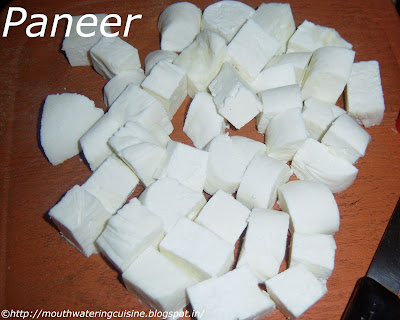
Paneer recipe is an unsalted white Indian cottage cheese. It is used mostly in North Indian cuisine. It is made out of milk, adding acidic flavors to it.
This is not a recipe but is a process of making it at home. As a South Indian, I do not have habit of making it. Whenever I have to make any dish with it, I get it from near by stores.
But my North Indian friends inspired me to make it at home only and taught me. When I made it for the first time it was very hard and second time it was crumbled.
Thanks to my friends, again and again I pester them, taught me all the tricks involved in it. So here is the finest and softest ever paneer I made. And from then on wards no looking back and no buying it from stores.
To make it we can use lemon juice, citric acid or yogurt to make it. I prefer only lemon juice, reason I do not know.
Tricks behind getting soft paneer:
- Use full fat milk.
- When boiling milk cream floats on it, do not remove it, instead mix it with milk.
- Once ingredients added to milk for curdling, allow it curdle completely.
- Whitish whey should separate from it.
- Once done remove it from flame immediately, do not over cook.
- This makes harder paneer once set.
- Once heavy weight is placed to set, keep it for 30 – 45 minutes, not more than that.
- The more time we keep heavy weight the more crumbled one we get.
- Use it immediately with in a day or two.
Key Ingredients for Paneer Recipe:
- Milk – 2 ltr
- Lemon Juice – 3 limes
Characteristics and Texture of Paneer Recipe:
- Appearance: It has a marble-white color, greenish-ting if made using buffalo milk and a compact, close-knit body.
- Texture: It is characterized by a firm, cohesive, and spongy texture that is remarkably resilient; it can be sliced, grilled, or deep-fried without melting.
- Flavour: Its profile is mild and slightly nutty with a subtle acidic tang, allowing it to act as a “culinary canvas” that absorbs the complex spices of various dishes.
Nutritional Profile Paneer Recipe:
Paneer is often considered a “superfood” due to its dense concentration of essential nutrients.
- Protein: It is an excellent source of complete casein protein, providing approximately 18–21 grams per 100g serving.
- Micronutrients: It is exceptionally rich in calcium and phosphorus, which are vital for bone and dental health.
- Dietary Compatibility: Because the curdling process removes most of the whey, paneer has a lower lactose content than liquid milk, making it better tolerated by some individuals with mild sensitivities.
Paneer is the primary ingredient in iconic North Indian dishes such as Palak Paneer (with spinach) and Paneer Butter Masala. It also serves as a base for beloved Bengali sweets like Rasgulla and Sandesh, where it is used in its unpressed form, known as chhena.
Paneer Recipe | How to make Paneer at home
Ingredients
- 1 Ltr Full Fat Milk
- 2 Lemons Juice
Instructions
- Add little water in a thick bottom pan.
- Add 1 liter milk to it and allow it to cook in low flame.
- Let the milk boil for five minutes.
- Once the cream starts forming on top it, mix it well.
- Take juice of two or three lemons. Pour it in the boiling milk slowly.
- While adding lemon juice stir the milk continuously.
- When the milk starts curdling, switch off the flame.
- Allow the milk to curdles completely. Remove from flame.
- Take a muslin cloth or any thin or any fresh kitchen cloth.
- Strain the milk and drain the whey.
- Collect the edges of the cloth together and tie it tightly and place it on a plate.
- Place any heavy weight on it, I used my mortar and pestle’s base.
- Remove the heavy weight after 30 mins, by which time paneer should be set.
- Cut it in desired shape.
- We can use paneer maker to do the same which is available in markets now a days.